Pinterest keyword tools estimate search volume using three core methodologies, they are official Pinterest Ads Manager API data, normalized visual search signals from Pinterest Trends, and third-party clickstream or Google Search volume extrapolations.
As Pinterest doesn’t provide true raw search volume data, all Pinterest keyword tools manipulate proxy data to create estimates.
Method 1: Pinterest Ads Manager API (Audience Reach Proxies)
The most accurate source of Pinterest keyword volume data is Pinterest Ads Manager.
However, it can only show you high level interests and the deep long tailed versions are often considered a part of high level interest.
For example: Ads manager data will show you interests for Home Decor as 5m but it wont show the data for “Living room decor under budget for easter”.
This is because this query is considered inside the broad category of Home Decor.
And to uncover such types of queries you will need to use the tool, because without the tool you won’t be able to figure out the existence of such queries in the platform.
How It Works
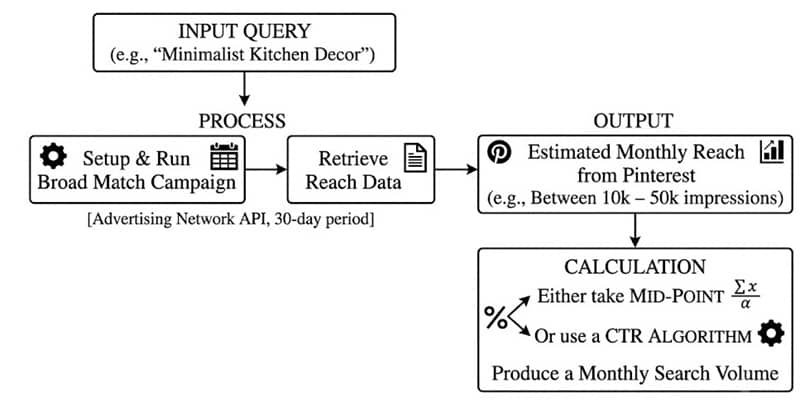
When creating a targeted ad campaign, Pinterest provides a rough audience size estimate associated with your chosen keywords. This can be pulled manually or using API tokens through automated scripts (which our Pinterest keyword tool also does by the way).
The Computational Mechanism
Input – Query (e.g. “Minimalist Kitchen Decor”)
Process – A broad match targeting query is set up in the advertising network API. This will run over a 30 day period.
Output – An estimated monthly reach from Pinterest (e.g. Between 10k – 50k impressions).
Once the output is received from Pinterest, the tool will either take the mid-point or use a CTR algorithm to produce a monthly search volume.
Limitations
This isn’t an actual search volume metric.
This only shows how many potential impressions there are for the advertisement.
This could be if someone scrolls past an ad in their home feed that relates to one of your target keywords.
Method 2: Pinterest Trends Engine (Normalized Relative Search Index)
Pinterest Trends provides normalized historical search data.
How It Works
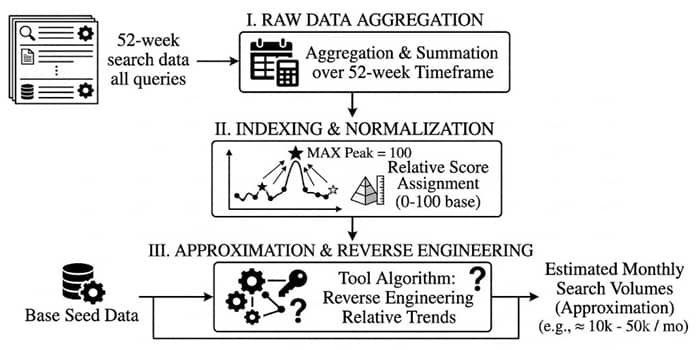
This works similar to Google Trends, by showing how popular a query is on a scale between 0 and 100.
Data Processing & Indexing
- Raw Data – Pinterest will calculate all searches made for your query within your chosen time frame (52 weeks).
- Normalized – The highest point of queries will be given a score of 100. All other historic data will be calculated based on that.
- Reverse Engineering – Third party Pinterest keyword tools will pull the relative search trends and use this against base seed data to calculate an approximation.
For example… If the keyword “Fall Outfit Ideas” scores 100 in October and 20 in April, this means it was 5 times as popular in October compared to April. This doesn’t mean 100 people searched for it.
Method 3: Third-Party Cross-Engine Extrapolation (Google + Clickstream Data)
Many budget or generic SEO tools calculate their Pinterest search volumes using other search engines.
How It Works
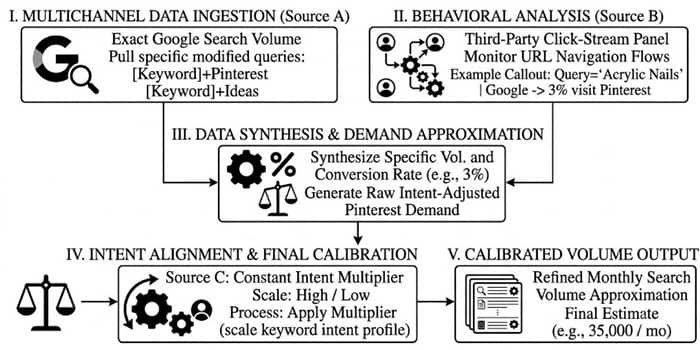
Google Volume – The tool will pull the exact monthly search volume from Google for [Keyword]+Pinterest or [Keyword]+Ideas.
Click Stream Panels – Third-party data brokers will monitor what URLs users are visiting. If 3% of all users who search for “Acrylic Nails” on Google go straight to pinterest.com, this will be used as an estimation.
Constant Multiplier – A constant multiplier will be applied based on the intent of each platform.
Operational Failure Point
Google has a high text based transactional intent, Pinterest has a high visual discovery intent. Merging Google data into Pinterest search volume will cause issues and inaccuracies for visual based niches such as Interior Design, Fashion & DIY Crafts.
This distinction between estimated proxies and real user intent is explored further in our Pinterest Keyword Research FAQ, which covers how platforms process keyword metrics.
Comparing Estimation Methods Across Pinterest Keyword Tools
| Estimation Method | Primary Source Data | Metric Type Delivered | Primary Advantage | Major Limitation |
| Ads Manager API | Ad Targeting Pools | Potential Impressions | Direct 1st Party Data | Confuses impressions from feeds and searches |
| Pinterest Trends Extraction | 1st Party Search Logs | Relative Index (0–100) | Accurate Seasonality & Historical data | Not raw, unindexed data |
| Cross-Engine Extrapolation | Google Volume & Clickstream Panels | Calculated Searches | Clear single data point | High assumption based on external engines |
Is the Pinterest Search Volume Data Accurate?
No. Single data points aren’t accurate. They’re estimations based on several factors. As Pinterest doesn’t have a public keyword API to pull raw monthly data, any tool that provides a single static number will be using some form of statistical modelling.
How Is Pintrendo Keyword Tool Different In Terms of Data Accuracy?
Unlike other Pinterest Keyword tools, Pintrendo makes use of different sources combined with Pinterest auto-suggest data to give you the difficulty score. So, it gives a difficulty score as that matters more than the volume. It does not provide volume as it can be misleading too.
This is done by a backend process that analyzes the Pinterest auto-suggest data, reading the trends, historical data analysis, human analysis layer for the limited data sets and the AI analysis to figure out if there is enough volume.
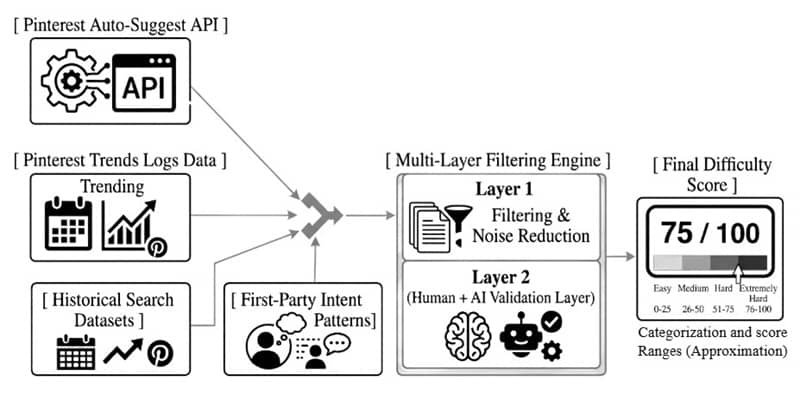
Once the tool processes all these through a complex workflow a finalized data is then presented.
Pintrendo, data involves different levels of filtering to give you the best possible dataset to work with and these datasets are maintained and updated manually wherever applicable so that you see the premium data.
Final Thoughts
Search volume in Pinterest Keywords tools is a relative metric.
You should look at the volume estimates, search intent and seasonality to ensure you get the maximum reach organically.
Do a thorough Pinterest Keyword Research by using the raw data to understand the relative opportunity, then analyse the queries against visual search patterns, and finally look at the first party Pinterest Trends data to ensure there’s enough interest.
The closest possible shortcut is to use Pintrendo Pinterest Keyword Tool as it analyses the seed keyword, then it runs through backend workflows to figure out the demand vs the volume to figure out the final difficulty score.
<< Back To Pinterest Keyword Research FAQs